Transformative Learning Solutions
Build people who can meet the moment.
Develop the judgment, courage, and capacity to act when the script runs out.
What we build. Why it matters. How we work.
Watch the welcome ↗Case study library
Small stories. Consequential shifts.
Completed work and representative engagement designs. Open any active case to explore the pressure pattern, intervention architecture, and evidence.
Case 01
UNDERPRESSURE
Private coaching mapped the protective rule interrupting access to what the professional already knew under interview scrutiny.

Case 02
Representative
GAME
A strategy design connects competing ambitions to a provisional direction, bounded bets, and clear rules for reopening decisions.

Case 03
Completed + anonymized
TRAVELS
TLS made the protective logic beneath five leadership priorities visible, testable, and connected to the conditions leaders create for their teams.
VISIBLE
A hybrid learning design connects significant work to enterprise impact, leadership contribution, and evidence proportionate to the claim.
Cases 01 and 03 are anonymized completed engagements. Cases 02 and 04 are representative TLS engagement designs based on real briefs; they demonstrate the method and evidence architecture without claiming realized client outcomes.
Work sample / Executive method brief
See the hidden logic before trying to change it.
A four-page executive introduction to Pressure Map™, the capacity-pressure-protection relationship, and the adult-developmental scholarship beneath the method.
Read here, open full screen, or download for later.Pressure Map™ is independently developed by Transformative Learning Solutions and informed by adult-developmental and Immunity to Change scholarship. It is not a personality assessment, psychotherapy, or third-party certification.
TLS / Adult Development at Work
Concept 01
Assumption-Maxxing
Make the hidden rule testable.
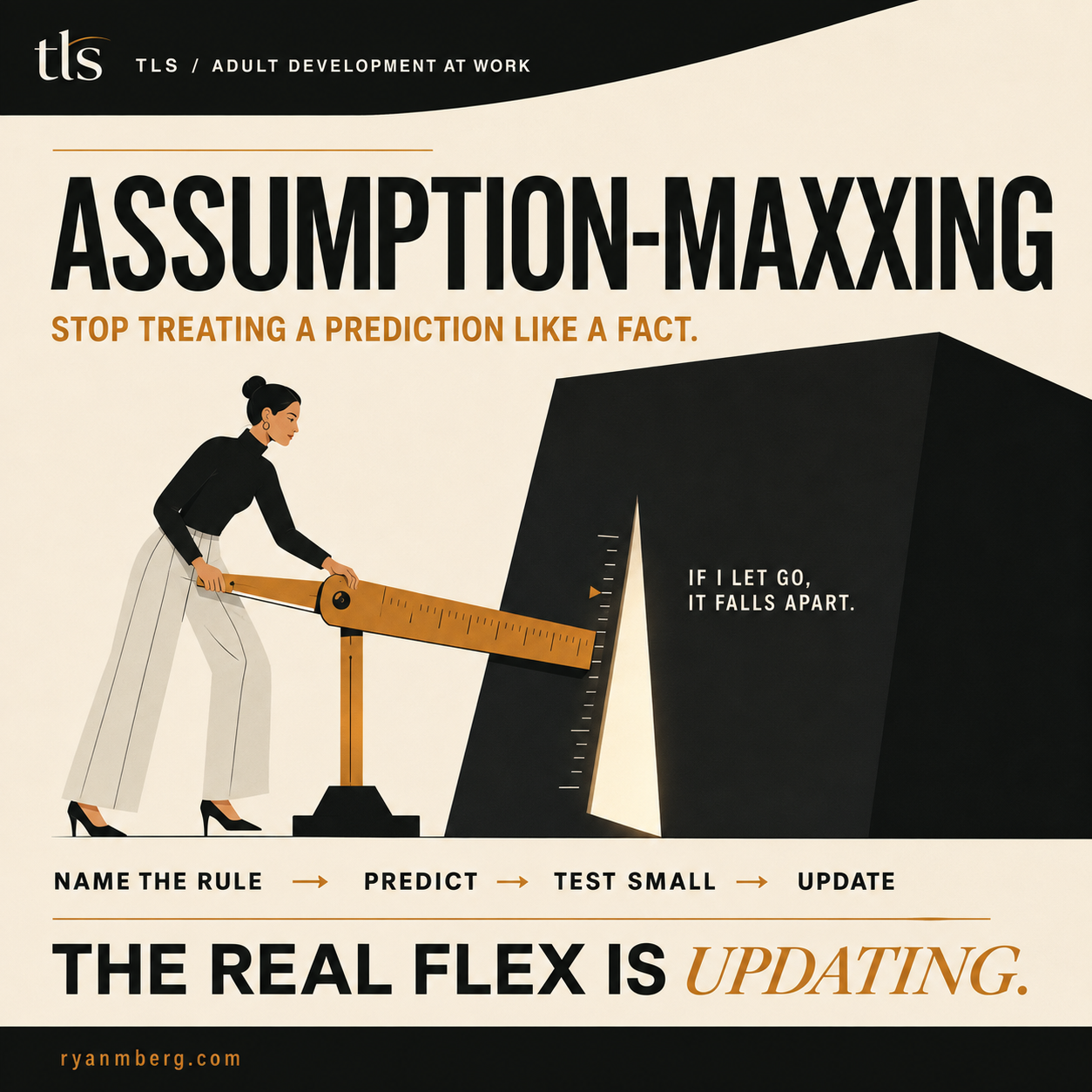
At TLS, we call this assumption-maxxing: the practice of identifying the hidden beliefs shaping our behavior, turning them into predictions we can actually test, and using evidence to update how we act. It is adult development translated into practical workplace language—not positive thinking or blindly destroying “limiting beliefs,” but building the capacity to examine the invisible rules organizing judgment under pressure.
- 01Name the rule
- 02State its prediction
- 03Test small
- 04Update with evidence
The real flex is updating.
Build this capacity with TLS ↗Build what the moment asks of you.
More capacity.
When it counts.
Think clearly. Hold a boundary. Share responsibility. Make a difficult choice—and stay open to what you might be missing.
TLS helps people develop the judgment, range, and steadiness to do those things when the stakes rise.
Find your starting point ↘Human development.
Grounded in real life.
One starting point.
Your own words.
01 / Recognize the capacity
What do you want to become
more able to do?
Start with a real moment in your life or work. Explore the language below. Keep what fits. Rewrite what doesn’t.
DOMAIN 01 / 13
Making my own choices
Develop the ability to choose from your own considered values while staying open to other people.
Try a word like “pressure,” “feedback,” “decisions,” or “meaning.”
↳ Choose a phrase to make it your own and see a possible practice.
Your starting point /
Put it in your own words.
A working goal, open to revision. Your words stay in this page until you leave or reload.
A possible first practice
What to look for
An illustration to adapt—not a prescription or a promise of change.
02 / Build the capacity
From a good intention
to a different move.
Knowing what to do is part of the work. TLS also helps you examine what makes it hard to do—and build the conditions for a new response.
Sometimes the next step is instruction or rehearsal. Sometimes it is a hidden rule to test—or a workload, incentive, or decision right that needs to change. We identify what the situation requires, then build the work around it.
One example / Holding a boundary
Make the goal specific enough to practice.
“Be more assertive” becomes “State a realistic limit before I agree to work I cannot responsibly take on.” We start with a meaningful goal and the moments that make it difficult.
“I want to make my limits clear even when someone might disapprove.”
Individual coaching · Team development · Learning experiences built around real work
Pressure Map™ is TLS’s applied method, informed by adult-developmental scholarship and Robert Kegan and Lisa Lahey’s Immunity to Change framework.
A capacity is developed in use.
Bring the moment.
We’ll build the practice.
A decision you keep reopening. Feedback you keep postponing. Responsibility you keep taking back. Start where the pattern is real.
Build capacity with TLS ↗Begin with your improvement goal →Executive curriculum / Series I
How adults actually change.
Most organizations treat change as an information problem. They explain, train, remind, and measure completion—then wonder why intelligent people return to old patterns when pressure rises. This eight-course executive series gives leaders a more accurate model of adult development: how meaning-making, identity, protection, role complexity, practice, and evidence shape the capacity people can actually access when the work becomes difficult.
Scroll, swipe, or use the arrows to explore the series.
Learning That Changes the Learner
How adult development actually happens at work
View curriculum↗
Distinguish learning that adds knowledge from learning that changes how a person interprets the work. Six scenarios bring authority, disagreement, ambiguity, and responsibility into focus. Connect developmental demands to challenge, reflection, support, and repeated practice, then build an application plan for one real assignment.
- Two kinds of learning, two different design questions7 minutes
Distinguish information and skill acquisition from changes in the way a person organizes meaning. Both can be necessary; neither should be treated as inherently superior.
Practice: Compare two scenario prompts: a leader who lacks procedural knowledge and a leader who knows the procedure but cannot tolerate the uncertainty it requires.
Output: A first-pass distinction between what the person needs to learn and what the person needs to become able to hold.
- Find the developmental demand inside the work9 minutes
Translate complexity into concrete tensions: independent judgment and accountability, loyalty and dissent, standards and delegation, or action and incomplete information.
Practice: Use two further scenarios to identify the competing demands a leader must keep in view, then rewrite a broad competency as an observable work requirement.
Output: A capacity-demand statement anchored in a specific decision or relationship.
- Notice the lens before adding another framework9 minutes
Examine how an interpretation can make one response feel necessary and other responses difficult to imagine. Introduce the move from being governed by a lens to being able to examine it.
Practice: Compare two final scenarios in which the same feedback or disagreement acquires different meanings; identify what each leader can see and what remains outside the frame.
Output: An event–interpretation–response trace and one question that opens another perspective.
- Build conditions for learning at the edge11 minutes
Connect consequential challenge with support, reflection, feedback, and continuity. Distinguish productive developmental tension from exposure without resources or recovery.
Practice: Redesign one live assignment using the reflection-workbook structure: demand, current approach, support, practice opportunity, review point, and adjustment trigger.
Output: A supported-practice design for a real assignment.
- Make a development claim that evidence can support9 minutes
Separate insight, improved task performance, and a more reliable change in perspective. Look for evidence across repeated situations rather than declaring growth from course completion.
Practice: Use the team-discussion prompts to select a baseline work example, one application opportunity, and a later review of what the leader noticed, held, and chose.
Output: An application and review plan with a bounded claim about what the evidence could show.
Back at work: Choose one recurring situation in which a familiar interpretation narrows your options. Before the next low-risk occurrence, record your usual reading, one alternative reading, and the response each makes possible. Try a proportionate new response, then review both the observable result and what changed in your interpretation; repeat before making a broader developmental claim.
Adapt the six scenario briefs, capacity language, and application assignment to the audience's actual authority, operating pressures, and learning-program context; retain the distinction between course learning and sustained developmental growth.
Most corporate learning adds new information to an existing way of seeing the world. This course helps leaders recognize the deeper form of learning required when the person’s current lens—not a shortage of knowledge—is limiting judgment. Participants learn how adults expand their capacity to hold complexity, examine assumptions, and respond with greater choice. The result is a practical executive model for distinguishing useful instruction from development that changes what a person can notice, understand, and do.
- Separate information acquisition from developmental growth
- Recognize work that requires a larger way of making meaning
- Connect challenge, reflection, support, and practice
When Knowing Isn’t Enough
Why smart, committed people repeat patterns they already understand
View curriculum↗
Investigate the gap between a sincere improvement goal and a repeated response under pressure. Follow a case through behavior, anticipated risk, protected commitments, and a working assumption using Pressure Map™. Branching decision points and a guided worksheet lead to a small test that can produce useful evidence.
- Describe the gap without turning it into a character judgment8 minutes
Separate the stated goal, observed behavior, context, and consequences. Consider knowledge, workload, authority, and incentive constraints before assuming the barrier is developmental.
Practice: Read the opening case and distinguish observations from labels such as resistant, uncommitted, or controlling.
Output: An observable intention–behavior gap and a list of other plausible constraints.
- Trace the moment pressure selects the familiar move10 minutes
Follow a trigger through interpretation, worry, and the action or avoidance that works against the goal. Notice the short-term relief and longer-term cost.
Practice: Explore alternate branches in the case: advice, reassurance, confrontation, and inquiry; predict how each response might affect the pattern.
Output: A trigger–meaning–response trace with the immediate payoff and downstream effect.
- Investigate what the pattern may protect12 minutes
Explore anticipated risk, deeper stakes, and possible competing commitments. A response can protect credibility, belonging, standards, or another valued good while still causing harm.
Practice: Use the guided worksheet to ask what the case subject worries would happen if they did the opposite; develop several tentative explanations and identify what must be checked with the person.
Output: A provisional Pressure Map™ linking goal, counter-pattern, worry, and possible protection.
- Turn a governing rule into a testable prediction11 minutes
Distinguish a feared consequence from an established fact. Form a working assumption that makes the familiar move understandable without presenting an inferred motive as the person's truth.
Practice: Rewrite one case assumption as an if–then prediction; specify a small, reversible action, necessary guardrails, and evidence that could support or complicate the prediction.
Output: A bounded-test card with prediction, new move, guardrail, and evidence question.
- Hold inquiry and accountability together9 minutes
Keep the performance requirement clear while inviting the person to author their own account. Review evidence before deciding whether to revise the map, the test, or the surrounding conditions.
Practice: Rehearse a manager or coaching conversation that names the observable effect, asks permission to explore the pattern, and agrees a proportionate next step.
Output: A conversation opening and an evidence-review agreement.
Back at work: With the participant's agreement, choose one manageable recurring moment tied to their own improvement goal. Record the anticipated consequence of a different response, try one small reversible move with guardrails, and review what actually happened. Treat the result as evidence about that prediction in that context; revise the working map rather than claiming a single test has removed the pattern.
Build the proposed branching case around the organization's real change challenge, role relationships, and consequences; adapt the worksheet and conversation practice while preserving participant authorship and the distinction between hypotheses and verified facts.
Senior leaders are often fully aware of the behavior they need to change—and genuinely committed to changing it—yet continue producing the same result. This course replaces moralizing explanations with a more useful developmental one. Participants examine how pressure activates protective commitments that can overpower conscious goals while remaining coherent from the inside. Leaders leave better able to investigate repeated patterns without shaming people, lowering standards, or mistaking sincere intention for an adequate change strategy.
- Diagnose the gap between intention and repeated behavior
- Identify the protective logic operating beneath a pattern
- Replace exhortation with evidence-producing inquiry
Before You Buy the Training
Diagnosing the barrier before selecting the intervention
View curriculum↗
Investigate a performance problem before selecting the intervention. Eight business cases distinguish knowledge, skill, practice, structural, motivational, and developmental barriers. Use a decision tool to identify missing evidence, match the response to the constraint, and connect the investment to operating conditions and observable transfer.
- Define the performance problem before naming a solution6 minutes
Specify the required action, the current result, the circumstances, and the evidence. Distinguish a course request from a demonstrated learning need.
Practice: Compare the first two business cases and rewrite each request for training as a question about observable performance and context.
Output: A problem statement and the evidence needed to establish the gap.
- Distinguish knowledge, skill, and opportunity to practice10 minutes
Ask whether people know what to do, can perform it with feedback, and have enough supported opportunity to make it reliable in the real setting.
Practice: Use four contrast cases to match job aids, instruction, demonstration, coached practice, or workflow-supported rehearsal to the actual constraint.
Output: A learning-intervention comparison with a reason for each selected approach.
- Test structural, motivational, and developmental explanations10 minutes
Examine decision rights, incentives, resources, workflow, purpose, competing priorities, and the meanings attached to acting differently. Multiple barriers may operate together.
Practice: Work through the final two mixed-barrier cases; identify evidence that would distinguish an impossible operating condition from an avoidant pattern or an unsupported developmental demand.
Output: A barrier map showing primary and interacting hypotheses, plus disconfirming questions.
- Choose an intervention and identify who must change what8 minutes
Match the proposed response to the constraint and assign ownership across learning, management, systems, and operating design. Make dependencies visible before commissioning content.
Practice: Apply the decision tool to one of the eight cases and combine the minimum useful learning intervention with any necessary operating changes.
Output: An intervention rationale with owners, dependencies, and a small validation step.
- Make the investment reviewable6 minutes
Define what should change in work, how transfer will be checked, and what evidence would justify continuing, revising, or stopping the intervention.
Practice: Complete the investment checklist for a live or sample request, including baseline evidence, manager support, and a review decision.
Output: A concise training-purchase brief with a transfer measure and review trigger.
Back at work: Before approving one learning purchase, interview people doing the task and observe or inspect a representative work sample. Use the six-barrier tool to test the initial training explanation, then pilot the smallest plausible intervention alongside any required operating change. Compare performance with the baseline and decide what the evidence supports before expanding the purchase.
Adapt the eight case briefs and investment checklist to current transformation, adoption, compliance, or performance requests, using the organization's actual decision rights and purchasing process without assuming that one barrier category explains every case.
Training works when people need knowledge, skill, or structured practice. It cannot, by itself, repair misaligned incentives, unclear authority, broken workflows, or a meaning-making system organized to prevent a feared consequence. This course gives executives a disciplined way to distinguish among knowledge, skill, practice, structural, motivational, and developmental barriers. Leaders learn to stop purchasing content reflexively and start matching the intervention to the actual constraint on performance, adoption, or change.
- Distinguish six materially different performance barriers
- Select an intervention that fits the actual problem
- Reduce training waste and increase transfer accountability
The Mind at Work
How adults construct meaning around authority, identity, risk, and responsibility
View curriculum↗
Make workplace meaning-making visible through scenarios about authority, identity, risk, and responsibility. Separate events from interpretations, explore how credibility and belonging shape a response, and practice examining a lens that normally goes unquestioned. A meaning-making canvas brings perspective-taking into one consequential conversation.
- Separate the event from the meaning it acquires7 minutes
Distinguish observable events, interpretation, anticipated consequence, and response. The event constrains what is plausible, but does not explain every person's reading of it.
Practice: Compare responses to the same challenge, delegation request, or disagreement and identify which statements report facts and which supply meaning.
Output: An event–meaning–response trace for one perspective scenario.
- See how identity and belonging organize attention10 minutes
Explore how being a competent expert, trusted colleague, loyal team member, or responsible leader can become a stake in an ordinary work exchange.
Practice: Use paired scenario readings to consider several possible identity or relationship stakes; distinguish what the case establishes from what would need to be asked.
Output: A map of possible stakes and inquiry questions that avoid treating inference as fact.
- Move from looking through the lens to looking at it10 minutes
Introduce the subject–object distinction as a relationship to an assumption. What governs a response without examination may become something the person can notice, question, and hold as one perspective.
Practice: Use the meaning-making canvas to translate 'disagreement means disloyalty' or another case interpretation into an examinable proposition and alternative readings.
Output: A governing-lens statement, alternative interpretations, and an evidence question.
- Hold authority and responsibility without collapsing the tension10 minutes
Distinguish role accountability from personal certainty, control from stewardship, and respect for others from surrender of judgment. Consider how position affects which voices become audible.
Practice: Run a board or leadership dialogue around a contested decision, explicitly separating evidence, interpretation, role responsibility, and the choice that remains open.
Output: A dialogue record that preserves competing perspectives and clarifies decision responsibility.
- Carry perspective-taking into one real conversation8 minutes
Create enough distance to investigate a familiar reading while staying accountable for the effect of one's behavior. Perspective-taking does not require accepting every interpretation as equally supported.
Practice: Prepare an opening that names the observation, offers a tentative interpretation, asks for another view, and states the decision or agreement needed.
Output: A conversation plan and a later reflection question about what became newly visible.
Back at work: Before a manageable conversation that usually evokes a defensive or controlling response, record the event, your initial meaning, and a credible alternative. Ask one genuine question that could test your interpretation, then make the required work decision. Review what the other person actually said and whether your available responses widened; do not infer a stable developmental shift from one exchange.
Tailor perspective scenarios and dialogue prompts to governance, delegation, cross-functional authority, or people-leadership situations. Keep the work anchored in professional judgment and observable decisions rather than personality typing or therapy.
Leaders do not respond to workplace events directly; they respond to the meaning those events acquire through an existing lens. A challenge can become a threat to credibility, delegation can feel like loss of control, and disagreement can feel like disloyalty. This course makes that meaning-making process visible without turning development into personality typing or therapy. Participants learn how identity, belonging, competence, authority, and responsibility shape what adults notice—and what becomes difficult to see under pressure.
- Separate events from the meanings assigned to them
- Notice when identity threat narrows judgment
- Create enough distance to examine a governing lens
The Hidden Curriculum of Work
What a role requires a person to become—not merely accomplish
View curriculum↗
Read the developmental curriculum hidden inside a role. Explore transitions from personal expertise to enterprise judgment, from doing to enabling others, and from seeking approval to authoring a defensible position. Translate abstract capabilities into observable requirements and design supported learning through consequential assignments.
- Read the curriculum hidden inside the role8 minutes
Distinguish what a role must deliver from the perspective, responsibility, and exposure a person must be able to hold while delivering it.
Practice: Compare a task-focused job description with a role-demand case and identify the tensions that remain unnamed in the formal responsibilities.
Output: A role-demand inventory separating deliverables, tensions, and capacity requirements.
- Translate strategy into observable judgment10 minutes
Connect strategic priorities to real choices: enterprise versus local optimization, present performance versus future capability, and risk ownership across organizational boundaries.
Practice: Select one strategic requirement and specify a decision moment, the perspectives it requires, and the behavior that would show adequate judgment.
Output: A strategy-to-capacity statement with an observable work example.
- Make self-authorship relevant to responsibility11 minutes
Explore how a person forms standards, evaluates advice, claims a position, and owns consequences while remaining open to others. Self-authorship is not isolation, inflexibility, or disregard for legitimate authority.
Practice: Work through a role-demand case in which expert approval, belonging, or familiar success conflicts with the judgment the larger role requires.
Output: A developmental question about the person's relationship to standards, authority, and responsibility.
- Design a consequential assignment with support12 minutes
Use real work as a development setting with clear scope, authority, feedback, guardrails, and reflection. Avoid giving a larger task while leaving the enabling conditions unchanged.
Practice: Use the assignment builder to define the stretch, sponsor support, decision rights, evidence sources, and review points for one capacity requirement.
Output: A supported developmental-assignment brief.
- Improve the succession conversation9 minutes
Distinguish demonstrated past performance, experience, current readiness, and a development hypothesis. Document evidence and unknowns instead of converting labels into judgments about the whole person.
Practice: Complete a succession worksheet for an anonymized role transition and agree what additional work evidence would inform the next decision.
Output: A succession evidence note linking a role demand to development opportunities and review criteria.
Back at work: Choose one genuine responsibility in a possible next role. Give the person an agreed portion of that responsibility with explicit authority, sponsor support, and risk boundaries. Observe how they frame the problem, use other perspectives, make the decision, and account for consequences; use the review to refine the development plan rather than declare a global stage or fixed readiness verdict.
Build role-demand cases and assignment briefs around the organization's actual strategic priorities, leadership transitions, and succession decisions. Adapt the observable requirements to the role while retaining transparent evidence standards and supported stretch.
Every role contains a developmental curriculum. It asks people to hold particular tensions, take responsibility at a different scale, tolerate new exposure, and see beyond the perspective that made them successful before. Yet job descriptions usually name tasks while leaving these deeper demands invisible. This course helps executives translate strategy and role complexity into the judgment, courage, perspective, and self-authorship the work requires—making development a property of operating design rather than an activity separated from performance.
- Identify the developmental demands embedded in a role
- Translate strategy into observable capacity requirements
- Use consequential work as a structured development setting
The Capacity–Demand Gap
When the work exceeds the judgment people can reliably access
View curriculum↗
Examine a transition through the relationship between work demands, available judgment, and surrounding support. Distinguish performance, potential, readiness, and developmental capacity using risk-based scenarios. Build a capacity–demand canvas and a transition plan with proportionate stretch, explicit authority, and evidence reviews.
- Define the demand before evaluating the person7 minutes
Specify the complexity, time horizon, competing interests, and accountability built into the work. Separate legitimate demands from ambiguity created by poor operating design.
Practice: Use an enterprise-transition scenario to identify what is newly required and which conditions make the role harder than it needs to be.
Output: A concrete role-demand statement and a list of avoidable structural burdens.
- Separate performance, potential, readiness, and capacity10 minutes
Clarify what each term can and cannot establish. Strong results in a familiar role do not automatically demonstrate reliable judgment under the demands of a larger one.
Practice: Sort the scenario's evidence into past results, knowledge or skill, behavior under pressure, development opportunity, and unanswered readiness questions.
Output: An evidence table that prevents one impressive indicator from standing in for the whole judgment.
- Map the gap without labeling the person10 minutes
Compare required judgment with observed responses across relevant situations. Consider knowledge, practice, authority, workload, support, and protective interpretations as interacting explanations.
Practice: Complete the capacity–demand canvas and write alternative hypotheses for the point where performance becomes unreliable.
Output: A contextual gap map with evidence, uncertainty, and questions to investigate.
- Design a transition that makes learning possible10 minutes
Balance real responsibility with staged scope, sponsor access, decision guardrails, escalation triggers, and reflection. Distinguish support that develops judgment from rescue that repeatedly removes ownership.
Practice: Use a risk-based scenario to design a first responsibility, support cadence, and criteria for expanding or reducing the assignment.
Output: A transition action plan with ownership, supports, guardrails, and review decisions.
- Review readiness as an evidence question8 minutes
Look for reliable judgment across repeated work moments and pressure conditions. State the scope of any readiness conclusion and retain room for support, development, or role redesign.
Practice: Prepare a talent-committee review that distinguishes observation, interpretation, residual risk, and the next evidence-producing opportunity.
Output: A review brief with a proportionate readiness claim and an explicit next step.
Back at work: Choose a bounded decision that represents a real demand of the larger role. Agree the person's authority, available support, risk boundary, and review point before returning ownership to them. Observe framing, perspective-taking, tradeoffs, escalation, and consequence ownership across more than one occurrence; use the evidence to adjust scope and support rather than make an unsupported judgment about fixed potential.
Adapt risk scenarios and the capacity–demand canvas to executive transitions, succession discussions, or expanding team responsibilities. Use actual authority and risk constraints while avoiding stage labels, comparative adult rankings, or unsupported predictions of potential.
Organizations routinely promote people because they excelled at the previous level, then interpret difficulty in the larger role as a motivation or skill problem. This course helps leaders examine the gap between what a role demands and what a person or team can currently hold under pressure. Participants learn to distinguish performance, potential, readiness, and developmental capacity—then design support and stretch that build the missing judgment without labeling, ranking, or reducing adults to a developmental stage.
- Define the human-capacity demand inside a role
- Distinguish readiness from knowledge and past performance
- Design safer transitions into greater complexity
Growth at the Edge
Designing challenge, support, reflection, and continuity that produce development
View curriculum↗
Turn a consequential assignment into a structured learning opportunity. Calibrate challenge, specify support, and build reflection and feedback into the work. Use an experiment builder to connect a development goal to a bounded action, then create a 30-day application plan that supports learning across repeated attempts.
- Locate the learning edge in actual work8 minutes
Distinguish a developmental stretch from more volume, unfamiliar procedure, or unmanaged exposure. Identify the perspective or responsibility the assignment requires the person to practice.
Practice: Compare assignment briefs and identify which ask for a different way of judging rather than simply longer hours or greater output.
Output: A specific developmental demand tied to a consequential work moment.
- Calibrate challenge and preserve room to learn10 minutes
Consider stakes, novelty, duration, authority, resources, and current workload. Use signs of overload, avoidance, or repeated rescue as reasons to investigate and adjust the design.
Practice: In the design lab, resize an assignment by changing its scope, decision boundary, support, or exposure while preserving a meaningful stretch.
Output: A right-sized assignment brief with guardrails and adjustment triggers.
- Make support, feedback, and reflection part of the assignment11 minutes
Specify who supplies support, what feedback concerns, and when reflection occurs. Preserve the participant's ownership while making help available before risk becomes unmanaged.
Practice: Design a support contract and a short reflection routine separating event, interpretation, chosen action, effect, and alternative response.
Output: A support-and-reflection plan with named roles and review points.
- Build a small experiment that can teach something12 minutes
Translate a developmental question into a prediction, a proportionate new move, observable evidence, and a review decision. A test should investigate an assumption rather than merely prove a desired outcome.
Practice: Use the experiment builder to design a reversible test, challenge its evidence quality, and rehearse the first conversation or decision it requires.
Output: An experiment card with prediction, guardrail, evidence source, and debrief question.
- Create continuity across the first 30 days9 minutes
Plan repeated opportunities, feedback, review, and revision instead of a one-off stretch. Treat the first month as a learning cycle that may need to continue, change, or pause.
Practice: Build a 30-day application plan with a starting example, a first test, scheduled reviews, and a decision about the next level of responsibility.
Output: A 30-day practice cadence with evidence reviews and an explicit continuation decision.
Back at work: Select one low-risk part of a real assignment that requires a response beyond the person's familiar default. Agree support and guardrails, record a prediction, and try the new move. Debrief evidence with the participant, adjust the challenge or support, and repeat through the first month before deciding what larger responsibility is appropriate.
Use live leadership-program assignments or manager development goals in the proposed design lab. Adapt the support cadence, experiment scope, and 30-day plan to operational risk, workload, and access to meaningful practice rather than imposing a fixed challenge level.
Adults develop when consequential work asks more of them than their current way of operating can comfortably provide—and when the environment offers enough support, reflection, and continuity to learn rather than simply defend. This course shows leaders how to create productive developmental tension without manufacturing crisis or abandoning people to sink-or-swim assignments. Participants design right-sized stretches, feedback loops, and reflection practices that convert difficult work into evidence, increased range, and greater responsibility.
- Calibrate stretch without producing overload or retreat
- Pair challenge with support, continuity, and reflection
- Turn real assignments into developmental practice
More Knowledge, Same Mind
Why information can increase without changing how a person understands the work
View curriculum↗
Audit the relationship between a learning program’s developmental ambition, its activities, and its evidence of success. Compare additional expertise with a wider ability to interpret uncertainty, disagreement, authority, and failure. Use a redesign canvas to connect perspective-taking, supported work practice, and evidence of transfer.
- Audit the claim behind the learning investment7 minutes
Distinguish an information objective, a skill objective, a performance objective, and a developmental claim. Each requires activities and evidence appropriate to what is being claimed.
Practice: Review a program-audit scenario and underline where the language promises a larger perspective while the design mainly supplies content.
Output: A claim-to-design audit identifying what the program can reasonably establish.
- Recognize when expertise leaves the governing lens intact9 minutes
Examine how more frameworks or vocabulary can coexist with unchanged interpretations of disagreement, uncertainty, authority, or failure. Knowledge gains remain useful even when they do not demonstrate development.
Practice: Compare two leader responses using the same new framework: one repeats the familiar interpretation, while the other considers and tests a previously excluded perspective.
Output: A distinction between applying a tool and examining the lens through which it is applied.
- Define observable evidence of a wider perspective10 minutes
Specify what a leader could newly notice, hold in tension, or choose in a consequential situation. Distinguish fluent developmental language from work samples that show different judgment.
Practice: Create evidence criteria for a scenario involving competing stakeholders, ambiguous evidence, or a challenged decision; identify what would count against the growth claim.
Output: A capacity-evidence rubric with observable indicators and counter-evidence.
- Redesign the program around work, inquiry, and continuity11 minutes
Retain necessary content, then add opportunities to examine assumptions, encounter alternative views, practice under realistic conditions, and review evidence over time.
Practice: Use the redesign canvas to revise one program component, linking the intended capacity to a work demand, supported practice, feedback, and a later application review.
Output: A program-redesign canvas with explicit links between the learning claim, activity, and evidence.
- Evaluate transfer without overstating causality8 minutes
Compare baseline and later work examples across relevant pressure conditions. Consider manager support, role changes, practice opportunity, and other influences before attributing a change to the course.
Practice: Complete a transfer guide that specifies evidence sources, review timing, a proportionate interpretation, and a decision to continue or revise the program.
Output: A transfer-evaluation brief that distinguishes observed change from an unsupported causal or developmental conclusion.
Back at work: Pilot one redesigned element with a clear intended capacity and comparable before-and-after work examples. Review whether participants identify more relevant perspectives, hold the central tension, and choose differently when similar pressure returns. Record other changes in support or role conditions, and use the evidence to refine the program rather than treating a vocabulary gain or a single improved example as proof of adult development.
Apply the proposed audit scenarios and redesign canvas to an existing executive, leadership, or enterprise learning program. Adapt the evidence rubric and transfer guide to its actual work demands, available baseline data, review access, and justified scope of attribution.
Organizations can spend heavily on expertise while leaving the underlying lens untouched. People acquire more frameworks, vocabulary, and tools, yet continue interpreting uncertainty, disagreement, authority, and failure in the same way. This course helps executives recognize when additional information is valuable and when it is merely decorating an unchanged meaning-making system. Participants learn to look beyond completion and recall toward evidence that a leader can now see more, hold more, and choose differently in the moments that matter.
- Recognize expertise that expands knowledge but not capacity
- Define evidence of a genuinely enlarged perspective
- Measure whether development transfers under pressure
The policy changes.
What happens next?
Policy-to-practice analysis for organizations facing consequential change.
We read the documents, show what is changing, and turn the findings into clear questions, comparisons, and decision tools.
Trace the
consequence.
evidence of ongoing compliance.
A power to ask.
A duty to verify?
The large consequences.
Explore a lens ↓
Define the intended result, who it should reach, and the evidence that would show it happened.
Research depth. Practical agency.
Source-linked analysis, decision tools, and practice for asking better questions under pressure.
What we build
Learning for the moment the script runs out.
Learning should change what people can see, say, decide, and do.
Custom learning systems
Strategy, curricula, digital courseware, and live learning built around real work.
Leadership & bench development
Practice-rich development for managers, successors, and leaders under pressure.
Workplace safety & compliance
Prevention learning that builds practical action beyond policy acknowledgment.
AI adoption & organizational change
Human-centered learning for new tools, new workflows, and new expectations.
Professional development workshops
In person & live onlineBring the real work.
Build the capacity.
Feedback that gets softened. Decisions that keep reopening. Responsibility that gets taken back.
TLS turns the situations people actually face into facilitated inquiry, honest dialogue, and practice—so development connects to the work that needs to change.
Design your workshop ↗
How the learning moves
From the room.
Into the work.
A focused experience with a clear purpose, room to practice, and a next step participants can test.
- 01Before the workshop
Define the moment.
Clarify the capacity to build and the situations that make it difficult. Shape the session around your people, their context, and a meaningful goal.
- 02In the workshop
Work the pattern.
Use Pressure Map™, facilitated dialogue, and realistic rehearsal to examine what happens under pressure and practice a different response.
- 03Back at work
Take a test back.
Leave with a focused practice, a small workplace test, and evidence to look for—so the next real moment becomes a chance to keep learning.
Built around what your people
need to become able to do.
- Leadership & shared ownership
- Feedback & productive conflict
- Boundaries & sustainable work
- Human judgment with AI
Executive teams. Managers. Intact teams.
Bring the moment your people need to meet.
TLS / Field Notes
The work beneath
the work.
Research and practical inquiry into adult development, leadership, and the judgment consequential work demands.
Research into practice · Ryan M. Berg
AI & judgment
AI Adoption and the Judgment Debt We Are Failing to Count
A faster answer can hide a weaker capacity to question it. A practical framework for building AI adoption around the decisions people must still own.

Keep following the question.
9 more field notes · explore the collection
Adult development
Why Knowing What to Do Can Fail Under Pressure
A person can sincerely want change while protecting something the change appears to threaten. The useful move is to test the rule—and investigate the environment that taught it.

Learning design
The Course Is Finished. Has the Decision Changed?
A practical way to follow learning into work: identify the decision, make its reasoning visible, and measure what the workplace allows people to do with it.

Leadership
How Leadership Pressure Becomes Team Climate
A leader’s protective move can become everybody else’s operating rule. Trace the transfer before training the team.

Work & wellbeing
Burnout, Boundaries, and the Work We Never Budgeted
When a person stops supplying invisible capacity, the work system becomes easier to see. Use that moment to redesign the obligation.

Team climate
The Hidden Curriculum That Teaches People to Stay Silent
Stated values invite candor. Repeated consequences teach people what candor will cost. Study the second lesson.

Leadership
Promotion Changes the Source of Authority
A stronger leadership bench starts by naming what the next role asks people to reconsider about expertise, responsibility, and belonging.

Adult development
Self-Authorship Without the Certainty Trap
When every option stays open, no choice receives enough commitment to teach you anything. A bounded decision can create evidence without demanding a permanent identity.

Policy & practice
Follow the Rule Into the Work
AI transparency rules sharpen an old organizational question: who can act, who can refuse, and who carries the cost when a policy reaches ordinary work?

Learning design
The Organization Is Already Teaching
A developmental organization treats ordinary work as a learning environment—and accepts responsibility for what its routines teach people to hide, notice, and attempt.
The person behind TLS
Research depth. Operator's judgment.
Ryan M. Berg studies how adults develop at work and designs learning for the moments that test them.
- Behavioral Scientist of Adult Development and Work
- Chief Learning Officer
- Ed.D. (ABD)
- Two-tour U.S. Marine Infantry Veteran
Start here
Have a consequential learning problem?
You do not need a perfect brief. Bring the pressure point. We will start there.